
Corporate India has put together a whopping $20 billion (Rs 90,000 crore) so far this year to fund its merger and acquisition bills abroad, surpassing all previous full year totals.
The World Economic Forum is preparing for the biggest annual event in its calendar, and Corporate India Inc plans to build on its India Everywhere campaign.
Even as India Inc talks of increasing corporate governance norms after the Satyam scam, a study by global consultancy firm Ernst & Young has said that more than half of the companies surveyed do not take into account risk of frauds in their annual audit plans.

India Inc's deal making saw a sharp decline in 2009 with just $24 billion worth of mergers and acquisitions and private equity deals taking place, but 2010 is likely to be a year of "opportunity," according to a report by a consultancy firm.

A total of 635 companies have declared their third-quarter results and reported 22 per cent rise in revenue and 47.3 per cent growth in net profit on an average.
An unstable government is the worst thing that can happen to the Indian economy grappling with the global downturn, say business leaders.

Major Indian automobile companies like Tata Motors, Bajaj Auto and Mahindra & Mahindra seem to have put up a robust performance in Q3 FY 10, paying advance tax of Rs 100 crore (Rs 1 billion), Rs 320 crore (Rs 3.2 billion) and Rs 195 crore (Rs 1.95 billion), respectively.

India's information technology (IT) spend is projected to touch $176.3 billion in 2026, rising 10.6 per cent from 2025, and outpacing the 9.8 per cent growth expected globally, according to the latest forecast by Gartner Inc., a business and technology insights company.

Nine of 10 bankers who attended the meeting admitted their sanctioned loan pipeline was shrinking fast due to tepid demand.

Chief executive officers (CEOs) across sectors have expressed intentions to expand capacities, expecting the government's target to invest a record Rs 11.11 trillion on infrastructure development will act as a catalyst for a jump in consumer demand. "With the government planning a capex of Rs 11.11 trillion, private sector investment will come in a big way. Companies will be preparing for it right from today," H M Bangur, chairman of Shree Cement, told Business Standard. For the past few years, the investment scene in India has been dominated by government capital expenditures; private investments in the manufacturing sector have remained muted.

The manufacturing sector (excluding petroleum sector) would report a 24.3 per cent PAT growth mainly on account of low raw material prices and soft interest rates, CMIE said, adding PAT of the financial and non-financial services would rise by 32.2 per cent and 20.4 per cent, respectively.

M&As are back on the radar for Indian companies, but with two vital changes. First, the average size of the deals are much smaller compared to the earlier years; and second, overseas acquisitions have taken a backseat.
One of the Rajus, chairman of non-banking finance company Nagarjuna Finance, K S Raju, was arrested for defaulting on repayments of public deposits worth around Rs 100 crore (Rs 1 billion).

India Inc is staring at significantly higher compliance and governance costs, following the Securities and Exchange Board of India's (Sebi's) latest tightening of disclosure norms and regulations around the filling of key positions, the materiality of information, and third-party transfers. Recently, the securities market regulator amended the Listing Obligations and Disclosure Requirements (LODR) to introduce a raft of changes that will affect how listed companies go about transparency and disclosures. The new framework will further empower public shareholders and soon move towards a 'comply or be penalised regime or comply or explain' in the case of high-value debt-listed entities.

The immediate concern for all companies is to prepare themselves - and their vendors and suppliers - for the new GST return filing mechanism, being test piloted from April 1.

Tax liability insurance is a key negotiation tool used by companies and advisers when a potential tax exposure has been identified and neither party is willing to bear the risk.
.jpg)
Q1 results indicate more pain ahead, as slowdown has spread to more sectors, pricing power has come down and rising interest cost is eating into profits.

A fundraising boom in the domestic market and tightening of the regulatory framework for overseas issues are responsible for this trend.
The study revealed that 83 per cent of Indian business leaders believe to have fair to good understanding on the issue of climate change. However, just under half of these respondents stated they have a clear strategy in place to respond to these issues. There is a significant gap between good intentions and action as only 21 per cent have measured their current carbon footprint, which is one of the first steps in defining a strategy to deal with the issue, the study noted.
In the first half of 2008, Indian companies accounted for a total of 34 US-bound acquisitions worth over $5.1 billion, US-based Virtus Global Partners said in its latest report on US bound acquisition by Indian companies. However, the volume of deals dropped 15 per cent to 34, from 40 in the H1 of 2007. Over 70 per cent of the transactions involved acquisition of 100 per cent stock for cash consideration.

A report by the Association for Democratic Reforms (ADR) reveals that the BJP declared the highest income among national parties in FY 2024-25, while the Congress's income declined.
A slowdown in the global economy and the rupee appreciation are expected to hit India Inc's job recruitment plans as the country's employment outlook dipped by six points to 74 points in the April-June 2008 quarter. The business outlook dropped by 9 per cent to 70 points, according to staffing agency TeamLease Services' quarterly Employment Outlook Report.
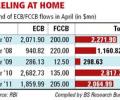
Around $1.54 billion was raised by 60 companies through the automatic approval route, which does not require the approval of RBI or the government, while $520 million was raised by the Exim Bank under the approval route, to meet its lending requirements abroad.
Ambani vs Ambani, Tata vs Birla, Ambani vs Mittal, the fights came in all permutations and combinations, making 2007 arguably the most happening as well as a tumultuous period for the Indian industry that stamped its authority overseas with about 250 acquisitions worth over $32 billion.
Leading political rallies or taking charge in boardrooms, the next-gen woman is taking it all in her stride.
India Inc will find the cost of fighting a legal battle going up if a suggestion by a Parliamentary Standing Committee to impose higher court fee for the corporate sector is accepted.
Net profit of FMCG, IT and pharma firms was up 33 per cent in the third quarter, accounting for nearly half of India Inc's profits ex-financials and oil.

Hailing Prime Minister Narendra Modi's Make in India campaign and the emphasis on ease of doing business, India Inc today said the initiative mirrors the country's ambition to sprint ahead in the global manufacturing race, thereby creating jobs and boosting economic growth.
The net profit of 82 firms up 20.2%, but topline growth slows to 14.7% on muted show by manufacturing firms.
President A P J Abdul Kalam on Tuesday exhorted India Inc to improve its competitiveness so that its position is bettered at the competitive index from the present 50th to within the top ten globally.\n\n

Finance Minister P Chidambaram announced the Union Budget 2013-14 in Parliament on Thursday.

Stocks such as NIIT, Punj Lloyd, Gati, Welspun India and BEML are favourites of the trading community.

The earlier government was blamed for non-performance, the current one will be rightfully blamed for mismanagement
Amid opposition from the private sector to reserving jobs for SCs and STs, the government on Tuesday said it will not impose quotas on India Inc, but only wanted more "affirmative action" from the industry for the socially underprivileged.
Some companies say they will pass on the cost to customers.
